“Denim washing process” is the sequence that turns a sewn garment into an approved wash look—dry effects, wet chemistry, drying, and QC against a sealed reference. This guide helps PD and sourcing teams brief that sequence without inventing recipes, MOQ, or lead times.
Search interest around denim washing process often pulls industrial flow charts and chemical lists. Buyers still need a different layer: which stages change shade vs hand vs local abrasion, what must be locked on the tech pack, and when a change forces re-approval. Use the overview below as a shared vocabulary with design and laundry partners.
What “denim washing process” means in development
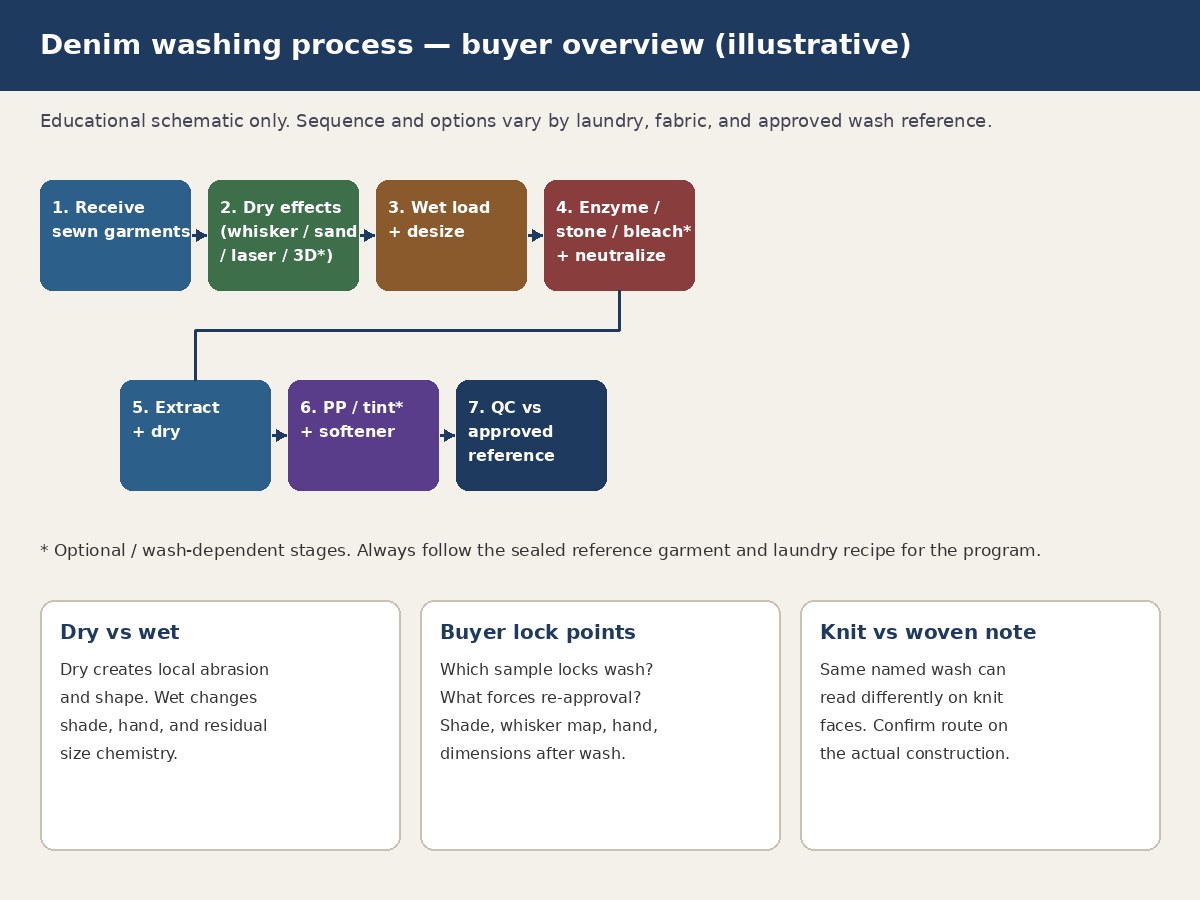
In factories, washing is usually a garment laundry route after sewing—not a single rinse. A typical educational sequence groups stages into:
- Receive sewn garments (and any dry-process queue).
- Dry process for local effects (whiskering, hand sand, grinding, tacking, laser/3D where used).
- Wet process load: desize, then enzyme and/or stone, optional bleach with neutralization.
- Extract and dry, then optional PP spray (with neutralize), tint, and softener cycles.
- QC against the approved wash reference before finishing/packing.
Exact order and which stages are optional depend on the approved wash. Treat public flow charts as literacy—not as your program’s recipe.
Dry vs wet: brief them as different decisions
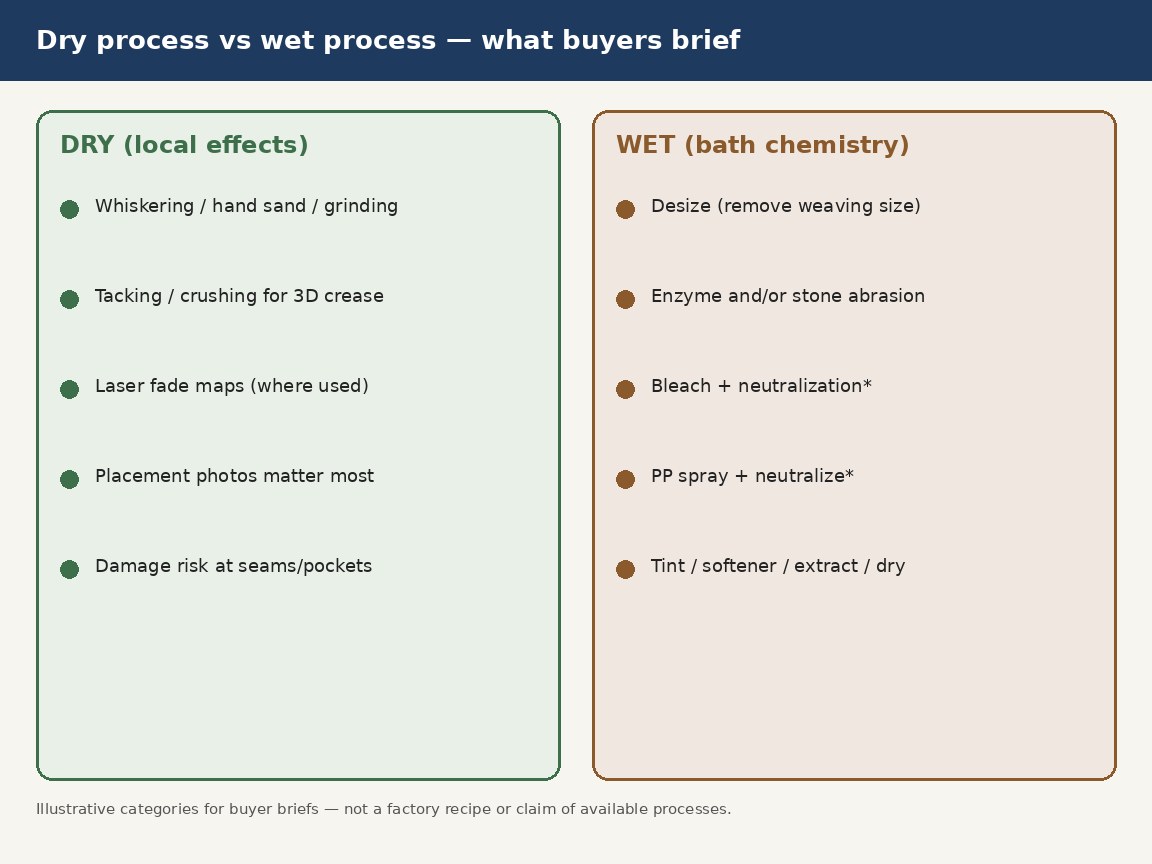
Dry effects are placement-heavy. Photos of hip whiskers, thigh grind, and pocket edges matter more than adjectives like “vintage.” Call out must-match vs directional zones.
Wet chemistry moves the whole garment: residual size removal (desize), surface abrasion and indigo lift (enzyme/stone), shade depth (bleach), and hand (softener). Back-staining, tensile loss, and shade drift between lots are wet-process risks buyers should discuss with partners—not assume from a moodboard.
For how to write effect acceptance language (whiskering, fade maps, enzyme hand), see how to specify denim wash effects for sampling. This article covers the process stages; that one covers effect specification.
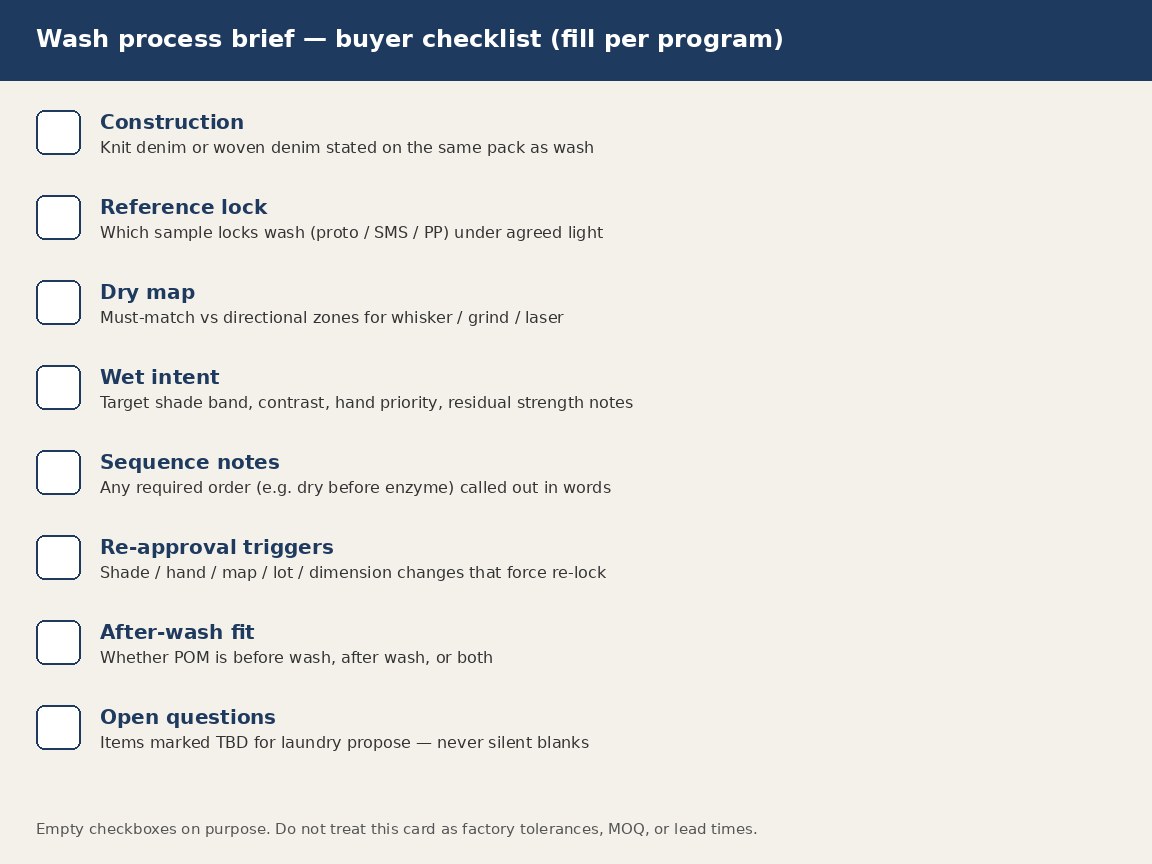
What belongs on the wash process brief
- Construction callout: knit denim vs woven denim on the same pack as wash (same named wash can read differently on knit faces).
- Reference lock: which sample locks wash (proto / salesman / PP) and under what light.
- Dry map: placement zones and intensity notes with must-match flags.
- Wet intent: target shade band, contrast, hand priority, and any strength or hand-feel constraints you already know.
- Sequence notes: if design requires dry before enzyme (or other order), write it—do not leave it as chat lore.
- Re-approval triggers: shade, whisker map, hand, fabric lot, or after-wash dimensions.
- After-wash fit: whether POM is before wash, after wash, or both (see also denim tech pack checklist).
Common buyer failure modes
- Approving shade on one wet route and fit on another wash state.
- Sending only Instagram crops for dry placement with no must-match notes.
- Treating “enzyme wash” as a complete brief (hand vs shade vs abrasion still need targets).
- Assuming knit-face programs will match a woven wash reference without a dedicated lock sample.
- Skipping re-approval after fabric lot or laundry line changes.
How this connects to sampling
Use the process vocabulary to ask better questions in sample rounds: Was dry done before wet? Was bleach used? Was PP applied after the first dry? Which garment is the sealed standard? Pair that with effect language from the wash-effects guide and the sections in your tech pack.
Before you assume a specialty route is available, read Denim Washing & Finishing and confirm via inquiry.
When this applies
- You are briefing a new wash or matching a reference garment’s process character
- Design, PD, and laundry disagree on what “same wash” means across stages
- You need a shared map of dry vs wet decisions before photo samples
Development risks
- Flow-chart literacy mistaken for a locked recipe
- Dry placement briefs without wet shade/hand targets (or the reverse)
- Fit and wash approved on different process states
- Knit vs woven construction ignored in wash matching
What buyers should provide
- Reference garment or photo pack with must-match notes
- Construction (knit/woven) and fabric context
- Shade, contrast, and hand priorities in plain language
- Which sample locks wash and what change forces re-approval
- After-wash measurement expectations
Related capabilities & next step
Denim Washing & Finishing · Sampling & Development · Specify wash effects · Denim tech pack · Request a Quote